Welcome to the Public Works blog.

Public Works is UNISON Scotland's campaign for jobs, services, fair taxation and the Living Wage. This blog will provide news and analysis on the delivery of public services in Scotland. We welcome comments and if you would like to contribute to this blog, please contact Kay Sillars k.sillars@unison.co.uk - For other information on what's happening in UNISON Scotland please visit our website.

Saturday, 20 January 2018

No 'fair deal' for councils

Barely a day goes by without another report on the impact of cuts on local services, as councils start the difficult process of managing yet another round of cuts.

Today, I was speaking at Scottish Labour's Highland conference in Inverness. The Highland Council's plans to cut services were all over the media this morning, a timely reminder of the problems that face councils across the country. As with most of these stories, they end with a Scottish Government spokesperson claiming that councils are getting a 'fair deal'.

Even allowing for the exigencies of government spin, this is simply not true. 

Councils have had an 8% cut in real terms since 2010/11. This isn't just down to Tory austerity, wicked though that is. Since 2013-14 council budget allocations have been cut by 6.9%, while the Scottish Government's Revenue Budget fell by 1.6%. Yes, there has been extra money for the government's priorities, but there has been a £590m cut in core funding. The money that pays for the basic local services that mark a civilised society. 

Council's have plugged the gap with a 13% increase in charges, a regressive tax that hits the poorest in society. They have also used up an unsustainable £79m of reserves along with £500m of cuts. The biggest impact has been in local employment, with 30,000 jobs gone since the crash. If councils have had such a 'fair deal', then why are 9 out of 10 austerity job cuts in local government?

The last minute budget deal last year helped, but it still left a £225m revenue cut, in a year when the when the Scottish Government budget went up. It was mitigated by £100m from the change in council tax bands and lifting the council tax freeze. However, that still left  a revenue shortfall of at least £55m. And that was just the consequences of central budget allocations. Councils faced additional unavoidable commitments like the apprenticeships levy and the cost of an ageing population.

In the current budget debate,the Scottish Government is receiving a £188m cash increase in its budget from Westminster, yet local government gets nothing. In real terms it is a £135m to £153m cut. Even if every council increased the council tax by the maximum 3% allowed, it would only generate £77m.

In practice, the cuts will be much worse because ‘real terms’ inflation will be much higher than the 1.4% assumed in the budget. The OBR forecasts are for RPI to rise 3.3% and CPI by 2.4%. There is no funding to meet the Scottish Government's new pay policy, which itself is less than the cost of living.

These are the numbers, but what about impact on services? UNISON has outlined the views of staff in eighteen ‘Damage’ reports. The common theme is that jobs are cut while demand increases, leaving staff stressed and demoralised while they attempt to keep basic services going. 

Even statutory services have been cut and preventative work dropped almost entirely. An example of this is building control. Even after the Grenfell Tower tragedy, building control staff spend little time inspecting properties, while they cope with vacancies and government bureaucracy.

These cuts have a disproportionate impact on low income families who have a greater reliance on local services. Less obvious is the impact on the economy. On Monday, the Jimmy Reid Foundation will publish a report commissioned by UNISON Scotland on this issue. It shows how local authority funding is crucial to sustain and grow economic and social benefits to local communities and society in Scotland as a whole.

We simply cannot go on like this. We need a proper reform local finance, including the use of discretionary taxation. An end to ring fencing budgets and for central government to properly fund its own initiatives that are delivered locally.

Of course we should also look at reform and the Local Governance Review announced by COSLA and the Scottish Government before Christmas is an important initiative. But that won't plug the gaping financial gap anytime soon.

Tory Austerity isn't ending short of a general election and the U.K. Government keeps digging itself a bigger hole rather than changing course. But that austerity has largely been dumped on councils in Scotland, and more. The suspicion is that's because it is far removed from ministers in Edinburgh.

Everyone who cares about democratically accountable local services should be making the case for fair funding in the current budget debate. That then provides the basis for a serious debate about strengthening local democracy.




Thursday, 11 January 2018

Protecting our pensions and the planet

Pensions are meant to safeguard our future, but that future is threatened by the burning of carbon in fossil fuels like coal, oil and gas. It's also a poor investment, which is why there is a growing movement to divest our pensions from fossil fuel investments.

I was in London yesterday for our UK annual pensions conference, which included the launch of UNISON’s new guide on this issue. It is designed to help members of local government pension schemes push for changes in the investment of their funds. The aim is to explore alternative investment opportunities, allowing funds to sell their shares and bonds in fossil fuels and to go carbon-free.

This is an issue that UNISON Scotland has championed for several years with our ReIvest campaign partners, FoE and Common Weal. Scottish Local Government Pension Scheme funds have some £1.8bn invested in fossil fuel companies - that figure grows to £16bn across the UK.


New government regulations for fossil fuels have raised the costs of high-polluting industries and reduced their investment appeal. Equally, emerging clean and green technology has created new and lucrative business opportunities for funds. The UK government is also consulting on allowing pension schemes to dump fossil fuel investments by dropping ‘best returns’ legal rules.

In Scotland, all local authorities, including those who administer the local SLGPS funds, have a statutory duty to reduce emissions in accordance with the Climate Change (Scotland) Act. That is an additional reason for challenging investment proposals to invest in fossil fuels.

One of the strengths of this new guide is to challenge the conventional wisdom that fiduciary duty is a barrier to divestment. The law is actually quite clear, pension funds should consider any factors that have a  financial impact on the performance of their investments, including social, environmental and corporate governance factors. Trustees can take account of non- financial factors where they have good reason to think that scheme members share their view, and there is no risk of major financial harm to the fund.

The guide also sets out a range of actions anyone who is concerned about this issue can take - not just our union branches and members.


By investing in fossil fuel extraction, our local councils are attempting to take a short term profit from climate change. As public bodies, councils have a responsibility to work for the public good,  they shouldn’t be financially and politically supporting the most destructive industry on the planet. Fossil fuel investments undermine existing Scottish and local authority climate change mitigation and adaptation strategies.

Let's protect our hard earned pensions and leave a planet fit for future generations.

Friday, 22 December 2017

Councils are not getting a 'good deal'

The Cabinet Secretary for Finance Derek Mackay says he has delivered a “good deal” for Scottish councils in the local government budget settlement. Well that’s a relief! Or it would be if it was true.

Lots of numbers are bandied about in relation to the local government budget. I dealt with the most common confusion over a ‘real terms’ increase in a previous blog post. So, let’s try and decipher what’s going on in local government.

Let’s start with the trends over recent years. Looking at the comparable, post police and fire transfer, years between 2013-14 and 2017-18, the local government revenue budget fell by 6.9%, whereas the Scottish government Revenue Budget fell by only 1.6%. This chart shows the trend in detail:


The most damming statistic relates to jobs. If local government has had such a ‘good deal’ then why are nine out of ten austerity job losses in councils?

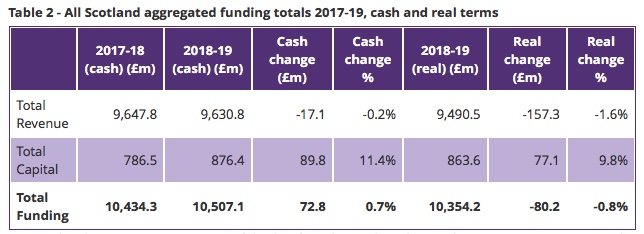
For the coming year the allocation of £9.63 billion is a “flat cash” settlement, but it isn’t a like for like comparison with the previous year. Next year’s funding includes new Scottish Government policy commitments such as starting to implement the expansion of Early Years and Childcare and ring fencing teachers’ pay and classroom ratios. These add up to a total of £153 million and once they are deducted from the “flat cash” settlement, there is a cut of £153 million for core local government services. 

This table shows how this is calculated. 


Even if every council raised the Council Tax by 3%, it only raises £77m. Certainly not enough to plug this gap. The finance minister’s claim that this would deliver a real terms increase, does not stack up.

We focus on revenue because that’s what pays for core services and of course pay. SPICe has estimated that, if local authorities were to match the Scottish Government's pay policy, this would cost around £150m (gross) in 2018-19. I think this is a little on the low side, but it’s difficult to be precise because of poor workforce data. In fairness, in real terms councils have 1% factored in for pay, so the gap is around £90m. 

We should also remember that because of the allocation formula the pain is not equally spread across councils. This chart shows the variations.


The bottom line is that the finance minister has been told to protect half the budget. That means that the other half takes a disproportionate hit. Most of that is local government, so however you try and spin it, councils are not getting a ‘good deal’.

Tuesday, 19 December 2017

Behaviour in Schools

The Scottish government published a lot of education statistics last week so the report into behaviour in schools didn’t get much coverage. Which is a shame because its important. What the report tells us is that cuts, particularly to classroom assistants and to specialist support staff, are creating problems in school when it comes to maintaining positive behaviour. This substantial report backs up what members told UNISON during our survey of school staff at the beginning of the year.

The new report finds that there has been an increase in low-level disruptive behaviour since 2012. Staff also reported that it is this type of disruptive behaviour that has the biggest negative impact on their experience in schools.

Head teachers, teachers, support staff and pupils all agree that there is a clear link between having sufficient support staff in a classroom and positive behaviour in that classroom. Staff also felt that the reduction in support staff combined with growing numbers of pupils with ASN had resulted in a shortage of one-to-one support for pupils and a wider negative impact on behaviour.

Again in line with UNISON’s research, it is clear that support staff do not have enough time for discussions with class teachers about pupils or involvement in whole school discussions about behaviour and relationships in schools. Headteachers also indicated that cuts in non-school based support for pupils with additional needs are also impacting on the level of support available to pupils. It is also clear that when resources in schools are stretched in general then that has an impact on other aspects of school life which could promote positive behaviour.
The report also states that

“There is also scope for improvement in relation to: ensuring that support staff feel valued, communication and training”

Earlier in the year our members told us the feel undervalued and the lack of time, lack of resources and heavy workloads mean they are struggling to maintain standards for pupils in Scotland. Things like the Summary Statistics for Schools in Scotland only including teacher numbers doesn’t help. This year they have added the numbers of early years workers with or working towards degrees but no numbers for those with other qualifications. Not counting these staff seems indicative of an attitude that these workers don’t count. The Behaviour in Schools report shows that they do.

We need to invest in and value the whole school team if we want to give pupils the best chance of succeeding.

Friday, 15 December 2017

Budget hangover

To use a seasonal analogy, some of us may be feeling the after effects of the office party. Well, the Scottish budget could have a similar effect on public finances later next year.

I have outlined the main impact of the budget on UNISON members in my budget briefing. One of the queries I often get from members is why there are different figures for the same budget or service. Public finance is confusing enough, even for budget geeks like me, without the added confusion.

The first reason is political spin. Politicians will conflate budgets to make their point, and sometimes, even count the same cash twice. The ring-fenced education budgets are an example of the former and social care the latter.

Another reason, and a legitimate one, is the presentation of a budget in 'cash' and 'real' terms. Cash is fairly straightforward. It's usually the amount on the cheque the public body will get from the Scottish Government - a bit like our own household budgets.

Presenting a budget in 'real' terms is an attempt to reflect the impact of inflation. To show if a budget is being increased or reduced to reflect policy priorities or a change in service level. Inflation is the increase in the cost of living, usually measured by an index. The main ones are the Consumer Price Index (CPI) which excludes housing costs, and the Retail Price Index (RPI) which includes them. Wage negotiations tend to focus on the RPI because most workers have housing costs of some sort.

The next complication is that when setting a budget the government is not looking at today's inflation rate, they are looking at forecasts for the next financial year (April 2018 to April 2019). This is done by the Office of Budget Responsibility (OBR) at UK level and the Scottish Fiscal Commission (SFC) in Scotland. The OBR has forecast that the CPI will be 2.4% next year and the RPI 3.3%.

However, there is another inflation rate called the 'GDP deflator' which government's use to present budgets in 'real' terms. This uses a different basket of goods and services from the better known CPI and RPI measures. The OBR forecasts that this will be 1.4% next year. So, when a budget line is described by Scottish ministers as a 'real term' increase, they mean only if inflation keeps at or below 1.4%.

Now, I personally think the OBR forecasts for CPI are optimistic, but I am pretty certain that 1.4% is not going to cover public service inflation in Scotland next year. For a starter, the Scottish Government pay policy is going to cost just short of 3% and that's 55% of the Scottish Budget. The NHS makes up a third of the budget and health inflation is always much higher than the standard measures. Then we have demographic change, which for social care requires a 2% increase just to standstill. I could go on, but you get the point. 

And let's not forget that local government isn't getting even this kid on real terms increase - they are getting a flat cash revenue settlement. In real terms the local government budget is cut by £135m, COSLA thinks it is closer to £154m. If you apply the points I make above, it's probably even bigger than that. To give some context, a 1% pay rise costs councils around £70m.

The concept of a 'real terms' pay increase also comes in here , given the Scottish Government pay policy. Even if RPI falls to 3.3% next year that still leaves those earning below £30k, who are promised 3%, out of pocket. Much more of a loss for those above £30k, who are only promised 2%.

In summary, I fear that if we swallow this draft Scottish Budget we will be left with something of a delayed hangover later next year. 

Monday, 11 December 2017

Eliminating fuel poverty requires more than a process

As the statutory target to eliminate fuel poverty in Scotland has come and gone, will a new strategy do any better?

The Scottish Government has published a consultation paper on a new fuel poverty strategy for Scotland. The consultation looks at the existing approach and legislative framework and sets out proposals for a new Fuel Poverty Strategy in Spring next year. Targets will be enshrined in a Warm Homes Bill later in 2018.

The number of households in fuel poverty fell slightly in the latest Scottish House Condition survey thanks to falling fuel prices. However, still almost one third of homes suffer under the current definition and the numbers are likely to rise again with the latest fuel price increases.


 The new definition excludes housing costs and is intended to focus attention on low income households, rather than the 47% of the current fuel poor who are not income poor. There will still be challenges in reaching the standard heating regime because households self-disconnect, due to low incomes. Cuts in social security will exacerbate this. While the new definition is certainly more complex, it does target efforts on the right group. Although with insecure work, varied incomes are more common and many households are likely to fall in and out of the definition.

There are three main elements to tackling fuel poverty - the price of fuel, energy efficiency/use and household income. The first is largely reserved, although energy policy is a factor. Energy efficiency is devolved and household income has devolved and reserved elements, including social security.

This means the strategy rightly has a focus on energy efficiency. Ambitions are fine, but investment is better. The Scottish Government cut funding to £45m in 2007/08; largely because they thought the problem had been resolved. It has now recovered to £129m, although this is well below the £200m Energy Action Scotland warned was needed to meet the 2016 target.

There are some particular challenges in Scotland. Not only are we a cold country, but fuel costs in rural areas are significantly higher. Typically, £2,200 in remote rural areas, compared to £1,400 in the UK as a whole. There are particular challenges in island communities. We also have large areas off the gas grid, which matters for heating.

It is also important that we retain efficient area based schemes that strengthen communities, rather than just micro targeting individual households. The proxies used to identify fuel poor households generally work, but need to be flexibly applied to reflect local needs.

The consultation paper is again strong on ambition. Objectives like 'Households are able to enjoy a warm home' is hard to disagree with. Achieving this apparently requires plenty of partnership working and linking in to other strategies. While this is probably true, it does feel rather process driven - hard targets, programmes and investment are in short supply.

A number of the organisations currently working in 'partnership' complain about short term funding. They build up expertise and services and then the funding comes to an end. Publicity, online and telephone services have their place, but for hard to reach households it requires an advisor in the household. There has been an improvement in skilling staff like social workers and community nurses, since some of the early schemes UNISON did with the Keeping Scotland Warm partnership. However, we could do more in signposting people towards specialist advice. Local authority services are under particular pressure due to cuts.

The new statutory target is to eliminate fuel poverty (new definition) by 2040, with a review at 2030. There is considerable scepticism of the description of this as 'ambitious', given the long timescale. We should have learned a thing or two during the past 16 years, to make another 23 year target a bit excessive.


The problem is that achieving this target depends on a range of variables, particularly fuel prices and incomes. None of these are likely to be addressed without a serious political commitment to eliminate poverty more generally.


Tuesday, 28 November 2017

School Infrastructure: Minister's Response to the Parliamentary Report

The Minister for Local Government and Housing, Kevin Stewart has now responded to the Education committee’s report into school infrastructure following the Cole Report. The Cole report was the result of an investigation into the collapse of a wall at Oxgangs primary school and the subsequent closure of 17 other schools.

UNISON evidence to the committee is available here. The remit of the Cole inquiry included

Reasons for the wall collapse
Use of private finance for the building work
The Council’s role in providing quality assurance of buildings

The Education Committee made a range of recommendations and the Minister has now responded laying out the Scottish Government plans going forward: He writes that the government will soon produce new procurement guidance for all public bodies and the Scottish Futures Trust. This new guidance will also include guidance on how public bodies can be “intelligent customers”.

Sadly they have not accepted the committee's recommendation that the route to quality assurance is through ensuring that public bodies employ a Clerk of Works for every capital project. The minister states that there are a range of methods but that guidance will identify "the critical value that a Clerk of Works role can bring to a projects but will also identify the conditions where a Clerk of Works may not be the optimal approach" There is also a plan for new research to support a review of what “reasonable inquiry” means and how local authorities can undertake them in their role as "intelligent customers".

The Minister states that has written to all authorities indicating that they must ensure that buildings no longer come into use without the appropriate building warrants. He has reminded them of their power/responsibilities and that they risk losing their verifier status if they do not use these powers.

Building standards teams will now be tasked with promoting their role as verifiers to the public and promote the Scottish government guidance. If responses to UNISON’s survey of our members in building standards are anything to go by this is the sort of thing they keeps them away from their central role of ensuring the safety of buildings and building work. They are building professionals not marketing/pr people. The teams are already overworked. There is no indication in the ministers response of any extra funding for local authorities to enable them to meet these requirements.

The Education and Skills Committee also recommended working with stakeholders including trade unions to improve training for construction workers and ensure we have enough properly trained skilled construction workers. UNISON is disappointed that the Minister’s letter refers to meetings and discussions with SBF, SQA and CITB but not with any trade unions.

UNISON report into the impact of cuts in Building Standards teams shows how much pressure they are under to maintain a high quality service.

• Almost half (48%) said there have been budget cuts this year while one in five (20%) said the cuts had been severe.

• There are 56 less staff working in Building Standards departments now than in 2010.

• The overwhelming majority (89%) feel their workload has got heavier in the last few years.

• Almost half (47%) felt they should spend a lot more time on site visits while just 13% felt they had the right balance between site visits and office time.

• Nearly 40% work unpaid hours ‘now and again’ while over a third (37%) work unpaid hours most weeks.

• 48% described morale as low, with over three quarters (78%) saying they don’t expect it to improve as a result of budget cuts, increased workload and lack of a pay rise.


Building standards play a vital role in ensuring public safety. There needs to be adequate funding and staffing in order to ensure they can undertake that role.