Welcome to the Public Works blog.

Public Works is UNISON Scotland's campaign for jobs, services, fair taxation and the Living Wage. This blog will provide news and analysis on the delivery of public services in Scotland. We welcome comments and if you would like to contribute to this blog, please contact Kay Sillars k.sillars@unison.co.uk - For other information on what's happening in UNISON Scotland please visit our website.

Showing posts with label Local Govt. Show all posts

Saturday, 20 January 2018

No 'fair deal' for councils

Barely a day goes by without another report on the impact of cuts on local services, as councils start the difficult process of managing yet another round of cuts.

Today, I was speaking at Scottish Labour's Highland conference in Inverness. The Highland Council's plans to cut services were all over the media this morning, a timely reminder of the problems that face councils across the country. As with most of these stories, they end with a Scottish Government spokesperson claiming that councils are getting a 'fair deal'.

Even allowing for the exigencies of government spin, this is simply not true. 

Councils have had an 8% cut in real terms since 2010/11. This isn't just down to Tory austerity, wicked though that is. Since 2013-14 council budget allocations have been cut by 6.9%, while the Scottish Government's Revenue Budget fell by 1.6%. Yes, there has been extra money for the government's priorities, but there has been a £590m cut in core funding. The money that pays for the basic local services that mark a civilised society. 

Council's have plugged the gap with a 13% increase in charges, a regressive tax that hits the poorest in society. They have also used up an unsustainable £79m of reserves along with £500m of cuts. The biggest impact has been in local employment, with 30,000 jobs gone since the crash. If councils have had such a 'fair deal', then why are 9 out of 10 austerity job cuts in local government?

The last minute budget deal last year helped, but it still left a £225m revenue cut, in a year when the when the Scottish Government budget went up. It was mitigated by £100m from the change in council tax bands and lifting the council tax freeze. However, that still left  a revenue shortfall of at least £55m. And that was just the consequences of central budget allocations. Councils faced additional unavoidable commitments like the apprenticeships levy and the cost of an ageing population.

In the current budget debate,the Scottish Government is receiving a £188m cash increase in its budget from Westminster, yet local government gets nothing. In real terms it is a £135m to £153m cut. Even if every council increased the council tax by the maximum 3% allowed, it would only generate £77m.

In practice, the cuts will be much worse because ‘real terms’ inflation will be much higher than the 1.4% assumed in the budget. The OBR forecasts are for RPI to rise 3.3% and CPI by 2.4%. There is no funding to meet the Scottish Government's new pay policy, which itself is less than the cost of living.

These are the numbers, but what about impact on services? UNISON has outlined the views of staff in eighteen ‘Damage’ reports. The common theme is that jobs are cut while demand increases, leaving staff stressed and demoralised while they attempt to keep basic services going. 

Even statutory services have been cut and preventative work dropped almost entirely. An example of this is building control. Even after the Grenfell Tower tragedy, building control staff spend little time inspecting properties, while they cope with vacancies and government bureaucracy.

These cuts have a disproportionate impact on low income families who have a greater reliance on local services. Less obvious is the impact on the economy. On Monday, the Jimmy Reid Foundation will publish a report commissioned by UNISON Scotland on this issue. It shows how local authority funding is crucial to sustain and grow economic and social benefits to local communities and society in Scotland as a whole.

We simply cannot go on like this. We need a proper reform local finance, including the use of discretionary taxation. An end to ring fencing budgets and for central government to properly fund its own initiatives that are delivered locally.

Of course we should also look at reform and the Local Governance Review announced by COSLA and the Scottish Government before Christmas is an important initiative. But that won't plug the gaping financial gap anytime soon.

Tory Austerity isn't ending short of a general election and the U.K. Government keeps digging itself a bigger hole rather than changing course. But that austerity has largely been dumped on councils in Scotland, and more. The suspicion is that's because it is far removed from ministers in Edinburgh.

Everyone who cares about democratically accountable local services should be making the case for fair funding in the current budget debate. That then provides the basis for a serious debate about strengthening local democracy.




Friday, 22 December 2017

Councils are not getting a 'good deal'

The Cabinet Secretary for Finance Derek Mackay says he has delivered a “good deal” for Scottish councils in the local government budget settlement. Well that’s a relief! Or it would be if it was true.

Lots of numbers are bandied about in relation to the local government budget. I dealt with the most common confusion over a ‘real terms’ increase in a previous blog post. So, let’s try and decipher what’s going on in local government.

Let’s start with the trends over recent years. Looking at the comparable, post police and fire transfer, years between 2013-14 and 2017-18, the local government revenue budget fell by 6.9%, whereas the Scottish government Revenue Budget fell by only 1.6%. This chart shows the trend in detail:


The most damming statistic relates to jobs. If local government has had such a ‘good deal’ then why are nine out of ten austerity job losses in councils?

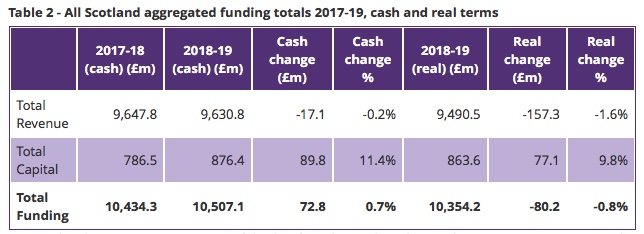
For the coming year the allocation of £9.63 billion is a “flat cash” settlement, but it isn’t a like for like comparison with the previous year. Next year’s funding includes new Scottish Government policy commitments such as starting to implement the expansion of Early Years and Childcare and ring fencing teachers’ pay and classroom ratios. These add up to a total of £153 million and once they are deducted from the “flat cash” settlement, there is a cut of £153 million for core local government services. 

This table shows how this is calculated. 


Even if every council raised the Council Tax by 3%, it only raises £77m. Certainly not enough to plug this gap. The finance minister’s claim that this would deliver a real terms increase, does not stack up.

We focus on revenue because that’s what pays for core services and of course pay. SPICe has estimated that, if local authorities were to match the Scottish Government's pay policy, this would cost around £150m (gross) in 2018-19. I think this is a little on the low side, but it’s difficult to be precise because of poor workforce data. In fairness, in real terms councils have 1% factored in for pay, so the gap is around £90m. 

We should also remember that because of the allocation formula the pain is not equally spread across councils. This chart shows the variations.


The bottom line is that the finance minister has been told to protect half the budget. That means that the other half takes a disproportionate hit. Most of that is local government, so however you try and spin it, councils are not getting a ‘good deal’.

Tuesday, 7 March 2017

Apprenticeship Levy - Keeping it local

With an ageing public sector workforce, we should be encouraging apprenticeships by passing the funding from the Apprenticeship Levy onto those public service employers who deliver quality apprenticeships.


This is Scottish Apprenticeship Week 2017, which focuses on the benefits apprenticeships bring to businesses, individuals and the Scottish economy - an opportunity to encourage more employers to offer quality apprenticeships. Events and activities involving employers, apprentices, colleges, local authorities and training providers are taking place across the country to celebrate the success of apprenticeships.


The UK wide Apprenticeship Levy is to be implemented from April 2017 and collected by the HMRC from large employers. Employers in England, including public sector bodies, will be able to directly access funding. However, in Scotland the money goes into the Scottish Government's budget - around £230m per annum.


Public sector employers in Scotland are important providers of quality apprenticeships. In a recent UNISON Scotland survey 81 per cent of apprentices described their training as excellent or good, even though almost half (46%) felt there should be a greater degree of off-the-job training. That is not to say there are not issues that need to be addressed. More than one in three (35%) rated their chances of achieving a job upon completion of their course as ‘don’t know’ or ‘unlikely’. Gender segregation also remains a huge issue. While the percentage of women employed in apprenticeships varied across councils, a strong pattern exists of women taking up apprenticeships in administration or care, while being almost completely absent from ‘craft’ apprenticeships.


Councils spend at least £25m on providing hundreds of valuable opportunities for young people such as modern apprenticeships, craft apprenticeships, graduate trainees, probationer teachers, formal work experience as employers that all contribute to the Developing Scotlands Young Workforce (DYW) Programme, jointly led by the Scottish Government and local government as partners.  This major programme aims to reduce youth unemployment by 40 per cent by 2021.


However, in Scotland the apprenticeship levy resource is not being passed on to these providers. COSLA has estimated that, based on last years pay bill for councils, the Apprenticeship Levy could potentially cost local authorities £24m as employers. That could rise to almost £50m across the public sector in Scotland.


Originally, local government understood that it would have its Levy funding returned in full in the next financial year by the Scottish Government.  Then councils were told that they were not to receive any of their own funding back from the Scottish Government. This decision undermines the DYW Programme and efforts to reduce youth unemployment in Scotland by putting in danger the future of valuable local initiatives provided by councils and other public service employers for young people. 


The bottom line is that apprentice recruitment is not happening at a sufficient rate to either: alter the ageing demographic of the workforce in public services; or replace the numbers leaving the workforce through voluntary redundancy or early retirement.


By centralising funding, the Scottish Government is discouraging public service employers from taking on apprentices. It is time to think again and return this funding to those local employers who want to develop quality apprenticeship programmes.

Wednesday, 2 March 2016

Welcome end to the council tax freeze, but this isn't a proper reform of local taxation

The First Minister has made the welcome announcement that the Council Tax freeze will end next year and has published the outline of some reforms to local taxation. The much needed detail is due in further consultation papers that will be published after the election.

The headline is some stretching of the higher bands. Bands A-D are unchanged and the others will increase as follows: band E - £105; band F - £207; band G - £335; band H - £517.

This does make the Council Tax more progressive, but it is hardly 'radical'. Stretching the bands was proposed in 2007 and rejected at that time by the SNP. Eight years later, at a cost of £3.15bn to local services, we have come full circle. Importantly, there is no indication that there will be a revaluation of properties, which means properties are allocated to bands based on 1991 property prices. Like a proper reform of the Council Tax, this was presumably put in the 'too difficult' file. Labour made the same mistake in response to the Burt Report in 2007.

There are some welcome changes to council tax benefit to provide additional support to families by increasing the child allowance within the council tax reduction scheme by 25%. Extending the council tax reduction scheme to exempt 54,000 households on low net incomes, but who live in higher property bands, appears sensible as well. No doubt those who understand the interaction with the benefits system will have views on these changes. Ending second home discounts and the development tax is also good news.

It is very welcome that the regressive council tax freeze will come to an end in 2017. However, councils are to be told that any increase must not exceed 3%. We also have a nice infographic telling us that that the new system means £100m for schools. Does this mean further ring fencing or ministerial direction? This goes to the root of the problematic relationship between local and central government in Scotland. It is for democratically elected local councils to decide what the council tax should be and what it should be spent on. Not big brother government in Edinburgh.

There is an outline proposal that councils could have a share of income tax revenues assigned to them. I suspect this is the First Minister's way of gently letting her supporters down over dumping the unworkable and unfair local income tax plan. However, I am frankly struggling to see how assigning revenues makes local taxation more progressive as the government claims.

The problem with assigned revenues is that they are largely cosmetic. UNISON opposed the Smith Commission plan to assign 10% of VAT revenues to the Scottish Government for the same reason.

It is not clear to me from today's announcement, how these assigned revenues will be adjusted to reflect economic growth. In any case, as the Scottish Government rightly argued in the fiscal framework negotiations in relation to their powers, councils have even fewer levers to influence economic growth. In addition, is the Scottish Government proposing to use income tax generated by payroll where taxpayers work, or where income tax payers reside. An important issue in a city like Glasgow with leafy suburbs. And we have to ask how an equalisation scheme would work. This chart highlights the problem.


The short answer appears to be that they haven't worked all this out, but needed to say something before the election. After eight years of inaction, we might have expected a bit more.

Of course all of this doesn't happen until 2017. The additional revenues won't save a local service or a job in the coming year. John Swinney made great play of council reserves over the weekend. His claims are exaggerated because the way council reserves are accounted for doesn't mean the cash is sitting in the bank ready to be spent. However, if I can pinch his own hyperbole, its not 'utterly exaggerated' - it is something we have highlighted before. Mind you, council leaders are entitled to a wry smile given John Swinney's own under spends with the Scottish Government's budget!

The promise of additional revenues next year may well encourage some councils to use reserves to plug more of the gaps in their budget. Others may have an eye to George Osborne's recent statements about public expenditure, as he digs a bigger hole for the UK economy. The problem remains that the Scottish Government has consistently shunted austerity onto councils. I have covered this before, but here is another chart that starkly makes the point.


The best we can say about today's announcement is that we are to be spared another pre-election council tax freeze bidding war, as in 2011. For that we should be grateful. However, after eight years of stop gap measures, we might have hoped for a proper reform of local taxation. Sadly, this isn't it.


Tuesday, 23 February 2016

Budget Bill - Stage 3

The Scottish Budget is debated at Stage 3 in parliament tomorrow. While there is plenty of pain for all public services, it is local government that is bearing the brunt of austerity in Scotland.


In our MSP briefing, I set out the implications of the budget for all public services - little of it is positive. However, the focus of the debate inside and outside parliament has rightly been on the local government budget settlement.


The budget allocation to local government in 2016-17 will be £10,152.3m, a substantial reduction on the 2015-16 allocation of £10,756.7m, even allowing for some reprofiling of capital expenditure. Within this allocation, the combined General Resource Grant + Non-Domestic Rates Income figure, which is used to calculate local government’s total revenue settlement, falls by 5.2%, or more than £500 million, in real terms (GDP deflator - inflation). The equivalent figure in cash terms is a reduction of 3.6%, or £349m. Both numbers are often bandied about, so it is important to differentiate them.


It is worth mentioning that the income from non-domestic rates is the second largest source of revenue after the Scottish Rate of Income Tax (SRIT). This year the estimated revenue is down by £31m, 2.8% in real terms. This decrease does not reflect the Scottish Government’s optimism about economic growth and in previous years the estimated income has risen considerably, e.g. by £150m last year. We can only hope that this isn’t a backdoor way of creating an under spend to the Scottish Government budget.


Scottish ministers often argue that local government has had a fair share of the Scottish budget over the years. This is a dubious claim when you consider that councils are the only main spending portfolio to have suffered a cash cut. However, it certainly isn’t true this coming year. Local government’s percentage share of the Scottish budget also falls 1.7% from 32.3% to 30.6% in 2016-17 (although on a like for like comparison, the percentage share falls by 1.1%).


If we take a slightly longer look, we can see that the Scottish Government is cutting councils more than itself. Since the 2013-14 transfer of police and fire, the local government settlement has fallen by 1.9% in real terms (-£200.9m), whereas the Scottish Government’s DEL+NDRI has increased by 3.2% in real terms (+£1,018.8m). This chart from SPICe illustrates this point.


In addition, councils have been blocked from increasing the Council Tax. This brings the total cost of the freeze in 2015-16 to £630m, and the total cumulative cost from 2008-09 to 2016-17 to £3,150m. Just imagine how many services and jobs could have been saved with this resource.


COSLA has estimated that this settlement will result in 15,000 job losses. It is difficult to estimate actual losses because it depends on the services councils decide to cut and how they use reserves and other financial instruments. Unavoidable commitments, such as employer National Insurance contribution increases (£125m for councils alone), will add to the pressure. Even if 15,000 is at the higher end, we know for certain that of the 50,000 jobs lost in devolved services since the crash, 40,000 of those are in local government. That certainly feels like councils are taking the brunt of austerity.


As the First Minister has fairly pointed out, unless you increase the overall budget available, protecting one service area inevitably means cuts to another. It used to be the case that the Scottish Parliament didn’t decide the size of the budget; it was largely limited to how it is divided up. That is no longer the case, because Parliament now has the Scottish Rate of Income Tax. We agree that the Calman powers are flawed, but they are still progressive and there will be an opportunity to make it more progressive when the new Scotland Bill’s powers are implemented.


I fully accept that the root cause of these cuts is the UK Government’s ideological attack on public services. However, devolution is about doing things differently in Scotland. We have the powers to mitigate austerity as we outlined in our report last year and by using the new tax powers. MSP’s should choose to combat austerity, not simply pass it on to community services.


Friday, 12 June 2015

Time for a political consensus on local taxation

The funding of local government in Scotland has been a difficult issue for political parties. At best proposals have been sticking plaster solutions because change is viewed as being politically challenging. However, we simply cannot go on as we are with short-term fixes that damage services and undermine local democratic accountability.

Today, I was giving evidence to the Commission on Local Tax Reform, a welcome cross party initiative co-chaired by the local government minister and the President of CoSLA.

In our submission we cover the piecemeal attempts at reform and highlight the damage that quick fixes like the Council Tax freeze are doing to local services. Increasing charges is a regressive substitute for progressive taxation.

A core element of our case for reform is that property is a significant form of wealth and must be taxed in order to reduce inequality. The well-off already own bigger and more houses than the rest of us. If this form of wealth is untaxed it becomes an even more attractive form of investment. This means that more people buy houses, not as a place to live but as an investment. This will add to our already dire housing shortages, increasing prices for both renters and ordinary buyers.

We set out five principles for reform:

• Local authorities should raise and control more of their own revenue. This will enable them to respond to and be more accountable to the communities they represent. About 85% of funding is currently determined centrally

• Councils should be able to set their own business rates, this will allow them to raise money to pay for services and devise their own criteria to support the type of businesses they want to encourage.

• A property tax is the best fit for local government as it is clearly linked to the authority. It cannot be moved or hidden making it cheap and easy for the local authority to administer.

• Central government funding should acknowledge local decision making and funds should be minimally ring-fenced.

Taxation should be broadly progressive, reducing the tax incidence of people with a lower ability-to-pay. It doesn't mean every tax has to be progressive, but overall, those on higher incomes should pay more.

Our submission also evaluates the options for reform.

We oppose a Local Income Tax primarily because it would be another tax on workers income and ignores the wealth that resides in property. It would have to be administered and set centrally, undermining local democracy. There are also a range of practical problems in collecting and allocating a national tax to local authority areas. It could add as much as 6p to income tax.

Land Value Tax is a superficially attractive option, not least because it is a property tax and might be progressive in taxing the rich. However, this idea has been around for 150 years and their are good practical reasons why it really hasn't taken off. The biggest problem is valuing land while ignoring what is built on it. Most of us have a vague idea what our house is worth, but not a clue of the land value. In order to send out bills and ensure they are paid you also need to know exactly who owns all the land, where the borders are and where to send the bill to. The Scottish Government is working on a register of landowners but has a timescale of ten years to complete this work. We cannot wait at least another ten years for a new tax. If LVT is part of the solution it is as a central tax that could address issues like land banking, or possibly as a replacement for business rates, but not the Council Tax.

That leaves our preferred option of a Local Property Tax levied on a percentage of actual property values. The Burt Review found that using actual property values rather than banding was more progressive because it would get rid of the ‘cliff edge' where those on either side of a band with a small difference in property values have very different bills. On the other hand banding could reduce appeals. In 2007 he recommended it be set at 1% for same yield as the Council Tax and while this would have created one-third losers, half would be gainers. Any future bills must based on up to date property valuations and regular revaluations to prevent the current situation building up again.

The new tax would need to have effective mechanisms to protect those on low incomes. Exempting properties below a certain value is one possible way to do this as is the introduction of an appropriate benefit to ensure local authorities received funding, but still protects those on lower wages/benefits. Pensioners with high value properties and low incomes should also be allowed to defer payments, leaving a bill to be paid which would come out of their estate.

Local taxation is one of the most difficult problems for the Scottish Parliament to resolve. No one party wants to be responsible for a new tax. No one wants to pay higher bills, particularly when real wages are not increasing and other costs are rising. Those who get higher bills will campaign loudly against them, winners will quietly carry on.

Difficult though it is, we cannot continue like this. The Burt Report was essentially a technical report and of its time. This Commission needs to be much more political, making the case for taxation and local democracy. That's why we welcome this Commission and hope it leads to a political consensus that we can all move ahead with.


Friday, 13 February 2015

Global Divestment Day

If we are to save the planet for future generations, it's time to take action against the power and influence of the fossil fuel industry.

13th-14th February is Global Divestment Day. Thousands of people across 6 continents taking collective action to show the strength of the growing global divestment movement and demanding our institutions go fossil free. The call for action in the UK comes in the form of a series of events targeting the health, faith, university, local authority and bank decision makers, as well as personal and political action.

As a pensions negotiator, I recognise that occupational and personal pensions are an important part of the campaign. The Scottish Local Government Pension Scheme invests £26bn of our members money and too much of this has been invested in ways that are harmful to our members.

There are several reasons why pension funds should stop supporting fossil fuel companies including:

  • Climate change. The carbon emissions of coal are higher than for any other fuel in the world. Recent estimates show that the vast majority of the world’s coal reserves will have to be left in the ground in order to avoid devastating climate change.
  • Destroying lives in the global south. Coal mining is responsible for devastating local pollution in the global south as well as the displacement of thousands of people from their homes.
  • Carbon bubble. Banks and other financial players have created a carbon bubble in the global economy. Only a small fraction of fossil fuel resources can be burned without breaking international commitments to tackle climate change. This means most fossil fuel assets are worthless. A sudden correction of the current overvaluation of fossil fuel companies could cause a new global financial crisis.

These are all good reasons for those making investment decisions to divest, even under the constraints of fiduciary duty. Those of us lucky enough to benefit from decent pensions should ensure they are used for good, not evil.

Divestment has been used effectively throughout history to place social and economic pressure on an industry or government that is causing harm. By publicly withdrawing financial support, fossil fuel divestment addresses the root of the problem - the unchecked expansion of fossil fuel companies on an endless quest for profit.

There are a range of actions you can take today and tomorrow on the campaign website. Either in Edinburgh or online. The planet and our children require us to take climate change seriously. #divest