Welcome to the Public Works blog.

Public Works is UNISON Scotland's campaign for jobs, services, fair taxation and the Living Wage. This blog will provide news and analysis on the delivery of public services in Scotland. We welcome comments and if you would like to contribute to this blog, please contact Kay Sillars k.sillars@unison.co.uk - For other information on what's happening in UNISON Scotland please visit our website.

Showing posts with label Public finance. Show all posts

Friday, 22 December 2017

Councils are not getting a 'good deal'

The Cabinet Secretary for Finance Derek Mackay says he has delivered a “good deal” for Scottish councils in the local government budget settlement. Well that’s a relief! Or it would be if it was true.

Lots of numbers are bandied about in relation to the local government budget. I dealt with the most common confusion over a ‘real terms’ increase in a previous blog post. So, let’s try and decipher what’s going on in local government.

Let’s start with the trends over recent years. Looking at the comparable, post police and fire transfer, years between 2013-14 and 2017-18, the local government revenue budget fell by 6.9%, whereas the Scottish government Revenue Budget fell by only 1.6%. This chart shows the trend in detail:


The most damming statistic relates to jobs. If local government has had such a ‘good deal’ then why are nine out of ten austerity job losses in councils?

For the coming year the allocation of £9.63 billion is a “flat cash” settlement, but it isn’t a like for like comparison with the previous year. Next year’s funding includes new Scottish Government policy commitments such as starting to implement the expansion of Early Years and Childcare and ring fencing teachers’ pay and classroom ratios. These add up to a total of £153 million and once they are deducted from the “flat cash” settlement, there is a cut of £153 million for core local government services. 

This table shows how this is calculated. 
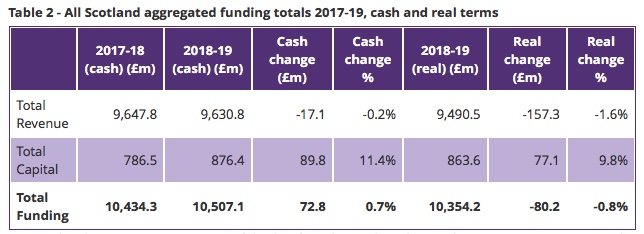

Even if every council raised the Council Tax by 3%, it only raises £77m. Certainly not enough to plug this gap. The finance minister’s claim that this would deliver a real terms increase, does not stack up.

We focus on revenue because that’s what pays for core services and of course pay. SPICe has estimated that, if local authorities were to match the Scottish Government's pay policy, this would cost around £150m (gross) in 2018-19. I think this is a little on the low side, but it’s difficult to be precise because of poor workforce data. In fairness, in real terms councils have 1% factored in for pay, so the gap is around £90m. 

We should also remember that because of the allocation formula the pain is not equally spread across councils. This chart shows the variations.


The bottom line is that the finance minister has been told to protect half the budget. That means that the other half takes a disproportionate hit. Most of that is local government, so however you try and spin it, councils are not getting a ‘good deal’.

Friday, 15 December 2017

Budget hangover

To use a seasonal analogy, some of us may be feeling the after effects of the office party. Well, the Scottish budget could have a similar effect on public finances later next year.

I have outlined the main impact of the budget on UNISON members in my budget briefing. One of the queries I often get from members is why there are different figures for the same budget or service. Public finance is confusing enough, even for budget geeks like me, without the added confusion.

The first reason is political spin. Politicians will conflate budgets to make their point, and sometimes, even count the same cash twice. The ring-fenced education budgets are an example of the former and social care the latter.

Another reason, and a legitimate one, is the presentation of a budget in 'cash' and 'real' terms. Cash is fairly straightforward. It's usually the amount on the cheque the public body will get from the Scottish Government - a bit like our own household budgets.

Presenting a budget in 'real' terms is an attempt to reflect the impact of inflation. To show if a budget is being increased or reduced to reflect policy priorities or a change in service level. Inflation is the increase in the cost of living, usually measured by an index. The main ones are the Consumer Price Index (CPI) which excludes housing costs, and the Retail Price Index (RPI) which includes them. Wage negotiations tend to focus on the RPI because most workers have housing costs of some sort.

The next complication is that when setting a budget the government is not looking at today's inflation rate, they are looking at forecasts for the next financial year (April 2018 to April 2019). This is done by the Office of Budget Responsibility (OBR) at UK level and the Scottish Fiscal Commission (SFC) in Scotland. The OBR has forecast that the CPI will be 2.4% next year and the RPI 3.3%.

However, there is another inflation rate called the 'GDP deflator' which government's use to present budgets in 'real' terms. This uses a different basket of goods and services from the better known CPI and RPI measures. The OBR forecasts that this will be 1.4% next year. So, when a budget line is described by Scottish ministers as a 'real term' increase, they mean only if inflation keeps at or below 1.4%.

Now, I personally think the OBR forecasts for CPI are optimistic, but I am pretty certain that 1.4% is not going to cover public service inflation in Scotland next year. For a starter, the Scottish Government pay policy is going to cost just short of 3% and that's 55% of the Scottish Budget. The NHS makes up a third of the budget and health inflation is always much higher than the standard measures. Then we have demographic change, which for social care requires a 2% increase just to standstill. I could go on, but you get the point. 

And let's not forget that local government isn't getting even this kid on real terms increase - they are getting a flat cash revenue settlement. In real terms the local government budget is cut by £135m, COSLA thinks it is closer to £154m. If you apply the points I make above, it's probably even bigger than that. To give some context, a 1% pay rise costs councils around £70m.

The concept of a 'real terms' pay increase also comes in here , given the Scottish Government pay policy. Even if RPI falls to 3.3% next year that still leaves those earning below £30k, who are promised 3%, out of pocket. Much more of a loss for those above £30k, who are only promised 2%.

In summary, I fear that if we swallow this draft Scottish Budget we will be left with something of a delayed hangover later next year. 

Wednesday, 14 December 2016

Time to look again at PPP schemes


The Scottish Government’s spending plans for 2017/18 is unlikely to be a cheery read when it's published on Thursday. However, when budgets are being cut, it is all the more important that government ensures that resources are not being wasted.


A good example of this is set out today in a joint Guardian/Ferret investigation into the Scottish government’s NPD model of PPP schemes in Scotland.


The report covers errors over interpreting EU rules which is expected to cost the Scottish government the equivalent of £932m in lost expenditure because it must now match the private finance spending under the NPD (PPP) programme with money borrowed from the Treasury. The scramble for matching funds is also expected to have knock-on effects on budgets.


The investigation also found that the private consortium building Scotland’s largest NPD hospital in Dumfries is expected to generate £160m in interest and finance fees on loans totalling £242m, including the £212m spent on building the hospital.

The consortium is charging an interest rate of 5.1% on borrowings of £218m. This results in the consortium earning more than £100m in interest payments from the public sector. It is also charging 11.3% on a further £24.2m in “subordinate debt”, which will earn financiers £37.5m in interest.


If Scottish ministers had instead used public borrowing they would expect interest rates from the state-run national loans fund of about 1.6%. If government argues that their borrowing consent was insufficient, then a deal could have been done with the local council who can also borrow at this rate.
 
A similar deal has been done by Northumbria Healthcare Foundation NHS Trust for its PPP contract at Hexham General Hospital, saving £67 million. This was funded by a loan from Northumberland County Council, which borrowed from the loans board.

This is precisely what UNISON Scotland suggested over a year ago in our ‘Combating Austerity’ report. We calculated that the austerity cuts in Scotland could be wiped out by refinancing PPP schemes in this way. Sadly, progress has been at a snail’s pace with a handful of projects being examined. Ironically, we believe Dumfries hospital may be one of those.


When jobs and services are being lost, it is absolutely vital that we chase every available saving. Effective monitoring, restructuring and refinancing PPP schemes are just some of the range of proposals we set out - and some authorities, to their credit, have acted on these. On PPP refinancing, it requires the Scottish government and their arms length agency the Scottish Futures Trust to take action.

Wednesday, 30 November 2016

Audit Scotland on Council Finance


Audit Scotland have published their annual  Financial Overview of Councils . It doesn’t paint a happy picture, in fact it should probably come with a soundtrack.

The report talks of ‘significant challenges’ for Local Government finance.  If that sounds like accountant speak for bad things – it is. Boiled down to its absolute basics they say “All councils face future funding gaps that require further savings or a greater use of their reserves.” For “further savings”  read “cuts.


The reports says that councils are, generally speaking, managing their finances well but that funding gaps are developing which will mean either more cuts or greater use of council reserves.  They urge councils to do more long and medium term financial planning but acknowledges that single year grant funding from the Scottish Government can cause problems with this.

 Overall Council Spending is at £19.5 billion. This is lower than in 2011/12 although spending on some services has increased - the most obvious being social care due to rising demand. Some councils are overspending on their social care budgets and Audit Scotland warn that this needs  to be tackled (BTW  that isn’t accountant speak for cuts – they mean that councils should be doing better at saying how much they will be spending on particular services).


Scottish Government grants are councils’ major source of income. Between 2010/11 and 2015/16, Scottish Government funding (combined revenue and capital) for councils reduced in real terms by around £186 million (1.7 per cent) to £10.9 billion. Taking into account 2016/17 funding, councils have experienced a real-terms reduction in funding of 8.4 per cent since 2010/11.


Councils have usable reserves of £2.5bn that can be used to support services . Most (23) Councils added to their reserves in the last year. Reserves can be used to support services but obviously this is not a sustainable source of long term funding. The Commissions estimate is that Councils are planning to use a total of £87m ( 75) of total reserves  in the coming year to plug gaps in funding . Reserves are what might be reasonably considered as rainy day money – and it might be reasonably considered to be wet weather  so there use to maintain services and jobs is a good thing. But as Audit Scotland point out , this is hardly a sustainable method of funding services.

Recent years have  seen a decrease in the amount of funding coming from Council Tax and in increase in both the number of services for which councils charge and the amount charged.  Councils are criticised for not being clear about how charging decisions affect local citizens.
Around 2250 staff  took packages and left Local Government in the last year giving a total of just over 13 000 staff leaving councils in the last five years .   Audit Scotland note that equal pay ‘remains a substantial issue’ for local government – they will publish a report on this in 2017

Councils spend around £1.5bn a year on servicing debt.  Most tales the form of traditional fixed interest rate loans. The exceptions to this are PFI /PPP/NPD and LOBO’s ( Lender Option, Borrower Option)  loans. The commission notes that PPP/PFI/NPD predict ( repaymants are often inflation dependent – so exact repayment levels  are more difficult to plan for) . This just backs up the case that UNISON Scotland has made that effort needs to go in at both council and Scottish Government Level  to explore either buying out or Combating Austerity toolkit these projects. It’s also the case trhat the Public Works Loan Board isn’t always the cheapest way of doing things either . Some ideas that might help kget the cost of debt down are explored in our combating austerity toolkit     

Looking ahead Councils are expecting demographic changes to put demands on key services like social care and are assuming a ride in the wage bill of between 1%-1.5% in each of the next two years. Overall  councils anticipate an £87m in-year shortfall between their  General Fund revenue income (before using reserves ) and expenditure. That’s after approving savings or cuts of £524m. You hum it he'll play it

In other news councils are also urged to do  more long and medium term financial planning but acknowledge that single year grant funding from the Scottish Government can cause problems with this.

The Audit Commission are also making it plain that  Councillors need to get better at scrutinising the plans put to them by senior officials Councils need to get better at explaining their financial position – so that it’s in an  understandable format for a wide audience.  Being polite accountant types who talk about savings rather than cuts they don’t say any more than that – but perhaps they might be thinking that the need  for councils to explain things might be about to go up sharply. For all too obvious reasons,  altogether now 


Thursday, 17 November 2016

A practical approach to reducing council debt

Council borrowing has come under scrutiny with a call from the Scottish Greens urging the UK government to write off what they describe as "unethical" loans made to councils in Scotland. This is similar to Unite the Union's, 'Scrap the Debt' campaign.

The response from the UK Treasury was a predictable - no chance. That doesn't mean the campaign call isn't justified. After all there is precedent with housing stock transfer, albeit that was to achieve a specific, if flawed, policy objective. It is also important to understand that councils have been borrowing from the Public Works Loans Board at rates well above the cost to the Treasury. In effect this has been a nice little earner for the Treasury.

I understand the campaign reason for the analysis by the Scottish Greens that councils are typically spending about 42% of the money raised by the council tax locally on servicing debts. However, this is misleading as only 15% of council revenues now come from the council tax, largely as a consequence of the regressive council tax freeze.

Commentators often erroneously explain council borrowing by making comparisons with personal finance. It has to be understood that councils are under a legal obligation to produce a balanced budget. They do not borrow money simply to pay for the running costs, this is for capital spending on schools and other services. The exception is PPP schemes, which are funded from revenue, at exorbitant cost.

As the Treasury is going to ignore this call for debt cancellation, we need to look at what else councils and the Scottish Government can do to reduce the debt burden.

Following a call by UNISON Scotland, the Scottish Government has relaxed the rules governing loans funds, giving councils greater flexibility. This could save councils in Scotland as much as £50m.

Councils should also be looking at their borrowing books and refinancing the older debt, in a similar way individuals shop around with their mortgages  The interest rates on some of this debt is way above current rates. The primary constraint is that some councils unwisely signed up for punitive repayment penalties. The worst, but not the only, example of high exit fees is the Lender Option Borrower Option (LOBO). As ex Barclays Capital employee Rob Carver put it: “You just need a Bermudan swaption pricer to know the relevant volatility surface, some kind of interest rate model calibrated to the appropriate processes and the full forward and spot curve". Understandably, not skills present in most council finance departments!

The other option for replacement and future loans is using bonds. Something that used to be commonplace, but has gone out of fashion. Around 60 local authorities in England and Wales have joined together in the Municipal Bonds Agency, which has the express aim of reducing council’s capital costs by arranging loans at cheaper rates than the PWLB. The English Local Government Association, which worked to set up the agency, estimates council savings on  financing costs over 30 years could be as high as £1.45 billion. They have already forced the Treasury to cut PWLB rates. Scottish councils have sadly been very slow to consider this option, the recent exception being Aberdeen City Council. In our 'Combating Austerity' report we calculated that councils in Scotland could have saved between £270m and £337.5m over 30 years by issuing their own bonds.

Councils and health boards should also be robustly monitoring and restructuring/refinancing their PPP schemes. Refinancing usually requires the approval of the Scottish Government, who have been slow to do this, although the SFT are looking at a few schemes. I suspect part of government's reluctance is that a major use of refinancing requires the cooperation of councils using their prudential borrowing powers. Better progress is being made with monitoring contract performance.

Calls for debt cancellation are justified and would be a much needed boost to council finances slashed by Tory austerity and more than passed on by the Scottish government. However, the Treasury is unlikely to change its mind and therefore we should be actively pursuing practical alternatives to the more expensive borrowing provisions commonly used by councils